- General
- Mould Illness (CIRS)
- Mould Illness (Non-CIRS)
- Mainstream Medicine
General Test Information
What test(s) can identify mould-related illness?
There is no single assay or biomarker which can conclusively identify mould-related illness. Diagnosis is usually formed by a mould-related Illness-aware health practitioner by thoroughly assessing a patient’s symptoms, past medical history, past interventions and environmental history in conjunction with examination, bedside testing and laboratory testing. An assessment of your home, workplace and/or place of education may also assist in the diagnosis, and. for this, one of the recommended indoor environmental professionals can be consulted.
CIRS Focused Tests
Dr. Shoemaker and colleagues proposed six biomarkers related to innate immune activation for diagnosing CIRS. These tests predominantly concern cytokine markers – compounds that fuel the fire of inflammation in the body – and hormone-related markers that become lowered in some cases of chronic biotoxin-related inflammation. All of these biomarkers have been thoroughly investigated in and of themselves within the medical literature, sometimes in relationship to other medical conditions. However, the proposal that they relate to biotoxin-related illness is relatively new and not yet well established.
The six core biomarkers most often used to diagnose CIRS are:
- alpha melanocyte stimulating hormone (a-MSH)
- Vasoactive Intestinal Peptide (VIP)
- Vascular Endothelial Growth Factor (VEGF)
- Matrix Metallinoproteinase 9 (MMP-9)
- Complement 4a (C4a)
- Transforming Growth Factor beta (TGF-b).
Visual Contrast Sensitivity
Blood tests (Medicare rebate)
The following are blood tests with Medicare item numbers. To have these bulk billed will depend on the willingness of your physician to tick the direct bill (DB) box on a test requisition form. VIP and Leptin are the only two tests that fasting is required.
Having a HLA positive does not mean you have CIRS or are destined to develop CIRS but you may be more susceptible to develop it after sufficient exposure to damp and water-damaged buildings or other biotoxin exposures.
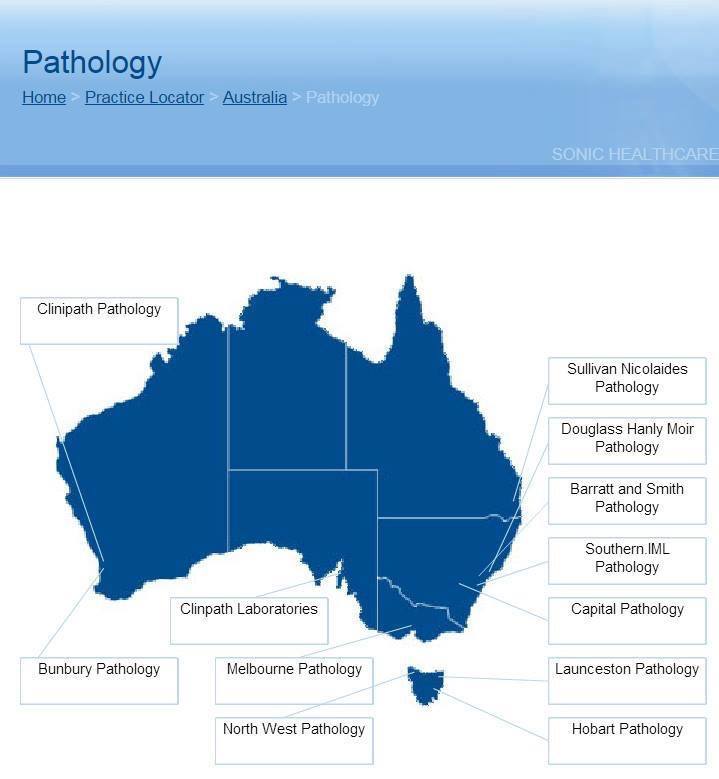 Correct laboratory group — Sonic Pathology
Sonic Pathology Australia are a network of pathology laboratories in every Australian state. See their website or the picture on the right (or above) for locations in your state.
Test information: HLA Panel Screen (DR and DQ)
Test name: Ask the GP to request “HLA DR-DQ typing” — Do NOT write coeliac
Medicare rebate
It can be fully or partly Medicare rebateable depending on your practitioner and laboratory. Medicare item number 71151. No rebate is available via NutriPATH.
NutriPATH do report the HLA DR/DQ test in the correct format also.
Test name: HLA DQ/DR Genetic Studies
Test number: 3401
Interpretation
Interpretation can be done by a Mould Illness/CIRS-aware health professional or via the HLA calculator.
Blood tests (Out-of-pocket)
Nasal Swab for MARCoNS and Fungi (Out-of-pocket)
- Obtaining the collection tube
- Microbiology DX will FedEx collection kits free worldwide, visit the Order Kits page (add Australia to the “City, State, Zip” field) . You don’t have to use FedEx to send the sample back.
- Requisition form (PDF).
- Ideally email them and ask for the Remel® BactiSwab™ wire shaft transport swab – although the default swab will suffice.
- Performing the swab
-
- This can be done by a doctor or patient.
- Read the Microbiology Dx instructions or read the blog post on Biotoxin Journey for directions.
- Sending swab to Microbiology Dx
-
- When used with the correct swab, the sample is viable for up to 30 days. There are several options for sending it to Microbiology Dx. Write “non-infectious sample” on the customs form.
- Australia Post air mail. The cheapest option.
- FedEx. Supplied with the kit from Microbiology Dx.
- When used with the correct swab, the sample is viable for up to 30 days. There are several options for sending it to Microbiology Dx. Write “non-infectious sample” on the customs form.
- Biofilm analysis
- This additional test will rate the strength of the biofilm from 0 to +3 if MARCoNS is present. Generally deemed unnecessary.
- Pricing
- MARCoNS: USD$100
- Biofilm analysis (if MARCoNS positive): USD$215
- Fungal culture: USD$95
- Microbiology DX
- 19A Crosby Drive
Bedford MA 01730, USA
P: +1 (781) 265 4956
W: microbiologydx.com
- 19A Crosby Drive
Test name: MARCoNS culture
Test code: 3404
Test name: MARCoNS & Fungal culture
Test code: 3418
Follow the instructions with the test kit supplied by NutriPATH.
MicroGenDx’s SinusKEY uses next-generation DNA sequencing (NSG) and qPCR to report a larger array of microbes than the culture methods by Microbiology Dx and NutriPATH.
Cost: US$264
Volumetric MRI (Part Medicare rebate)
NeuroQuant® (Cortech Labs) and iQ-COG™ (SNAC) are software that can quantify brain regions for microscopic changes via a specific MRI scan. These can aid in diagnosis and also for tracking brain changes.
49 Baden Powell Street
Maroochydore QLD 4558
P: 1300 697 226 / 07 5409 2800
scradiology.com.au
Have switched to iQ-COG (SNAC) from NeuroQuant.
Level 3, Xavier Building
360 Victoria Street
Darlinghurst NSW 2010
P: 02 8382 3495
svhm.org.au
I-Med Network Radiology
Suite 3, Level 1
38B Albert Ave
Chatswood NSW 2067
P: 02 8440 3100
i-med.com.au
There will usually be an additional charge for NeuroQuant processing by Cortechs labs or iQ-COG by SNAC.
Surviving Mold have an online NeuroQuant analysis available that you can enter your General Morphology report and be given a mold and/or Lyme score and also looks at multi-nuclear atrophy, traumatic brain injury and asymmetry. Cost is USD$25.
Dr Mary Ackerley, MD believes the Triage Brain Atrophy Report (TBAR), that takes into account normal ranges for patient sex and age, is more useful than the general morphology report alone.
iQ-COG
This is new vMRI software by Sydney Neuroimaging Analysis Centre (SNAC). It is unknown at present if results are comparable to NeuroQuant.
Non CIRS Tests
Urinary Mycotoxin tests (Out-of-pocket)
Urinary mycotoxin testing has proven an increasingly popular biomarker test in mould illness. There are three main laboratories in the US doing this testing; Great Plains Laboratory (GPL), Realtime Labs (RTL)/US Biotek and Vibrant. The first two have Australian distributors.
Realtime in their Mycotoxin Panel use enzyme-linked immunosorbent assay (ELISA) technology while Mosaic in their MycoTOX profile use liquid chromatography tandem mass spectrometry (LC-MS/MS) technology. As do Vibrant Wellness in their Toxin Zoomer.
Organic Acids Testing (OAT) (Out-of-pocket)
An OAT can show a number of markers of fungal and bacterial GI colonisation. In addition it reports markers of glutathione status, oxalate status, vitamin B status and metabolism.

You must be logged in to post a comment.